Publication: Physical controls on the shape of earthquake source time functions
Authors: Cheng-Yi Wang, Chun-Yu Ke
The earthquake source time function (STF), i.e., the seismic moment rate function, is a key observable of source dynamics, yet the physical origins of its diverse shapes, spanning sub-quadratic to super-quadratic growth, symmetric to asymmetric peaks, and abrupt to long-tailed decays, remain incompletely understood. Prior studies examined rupture initiation location, fault geometry, stress distribution, and frictional weakening individually, but not their combined effects on STF shape. Using spectral boundary-integral simulations of idealized overstressed-patch configurations, we show that four physical mechanisms each govern a distinct STF feature. Initiation location controls growth-phase curvature and symmetry, shifting moment rate growth from quadratic to nearly linear as rupture becomes increasingly unilateral. The background stress gradient acts almost exclusively on the arrest phase, with steeper gradients producing more abrupt termination, while overstress zone geometry governs plateau development and produces pulse-like slip without explicit self-healing. None of these structural controls reproduces the strongly early-peaking, long-tailed STF shapes common in natural earthquakes. Pronounced long-tailed behavior emerges only when the secondary frictional weakening distance is comparable to or exceeds total fault slip, consistent with scale-dependent breakdown. Combined simulations pairing initiation location with stress gradient and frictional weakening show the controls to be largely separable, though not additive in peak timing, so much of the diversity of observed STF shapes can arise from combinations of these mechanisms and heterogeneity-based processes not examined here. These findings provide an improved physical basis for interpreting STFs, with implications for seismic source inversion and near-fault ground motion prediction.
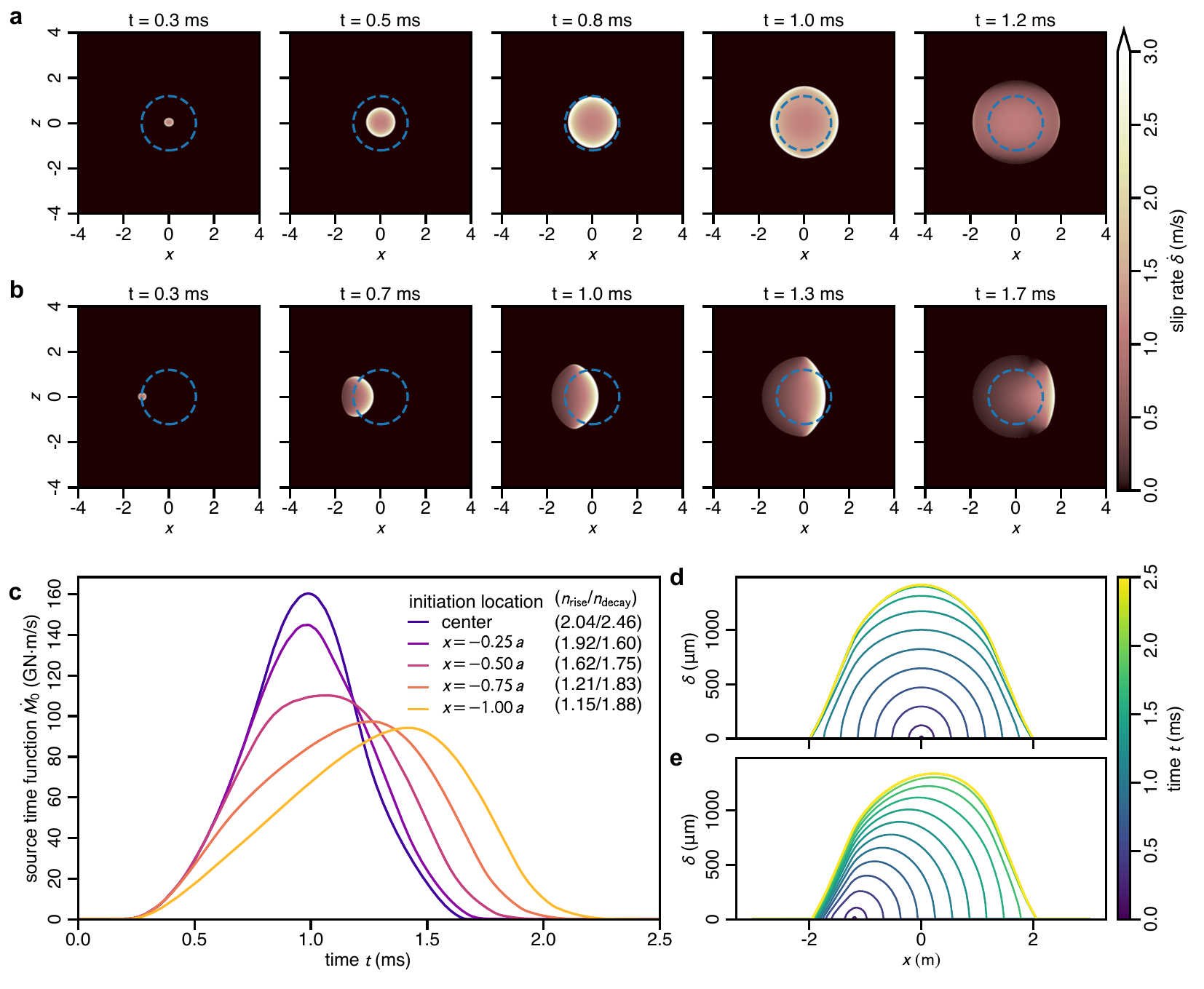
Wang, C.-Y. & Ke, C.-Y. (2026) Physical controls on the shape of earthquake source time functions. Journal of Geophysical Research: Solid Earth, in press. doi: 10.1029/2026JB034700. Preprint: 10.22541/essoar.15003400.